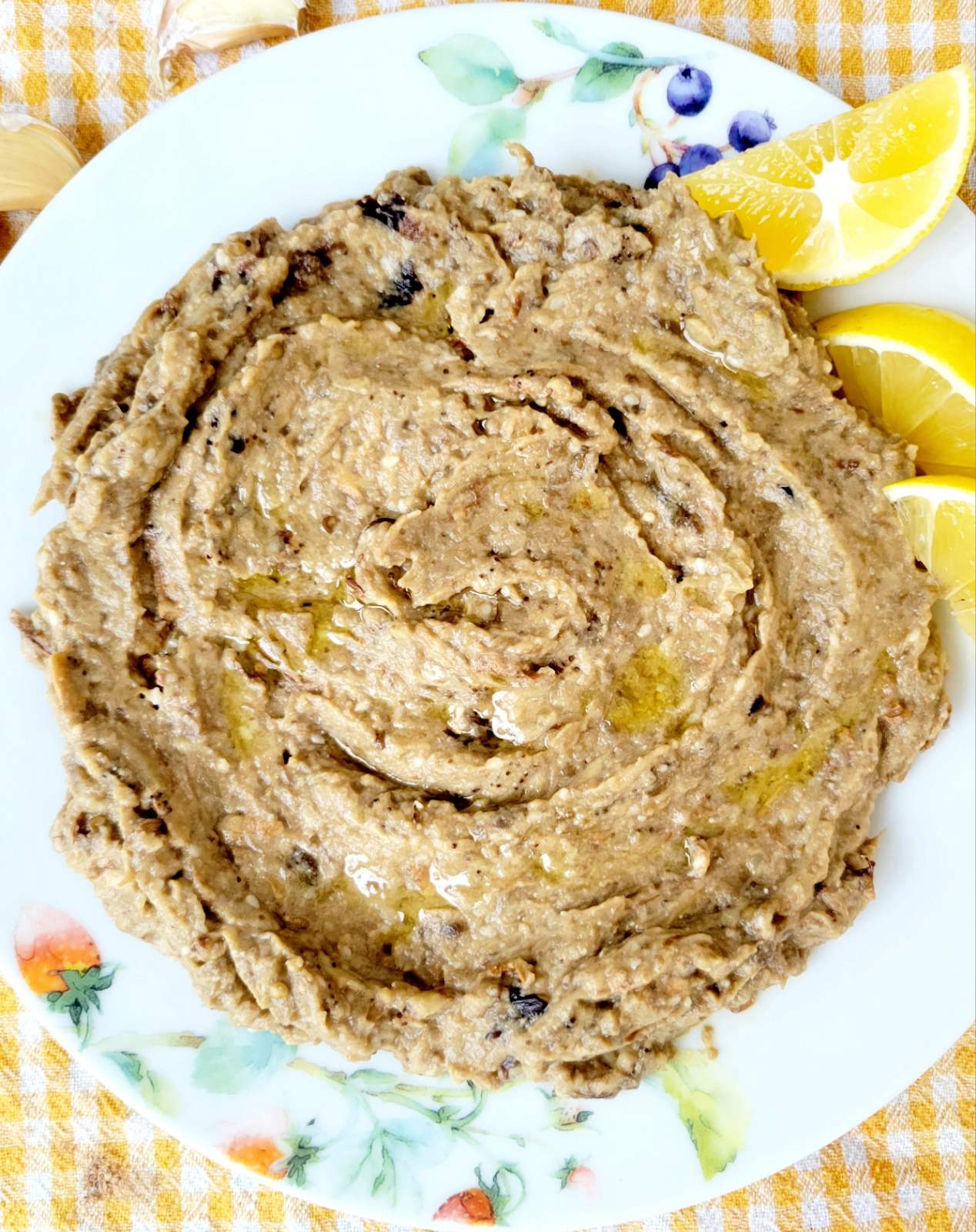
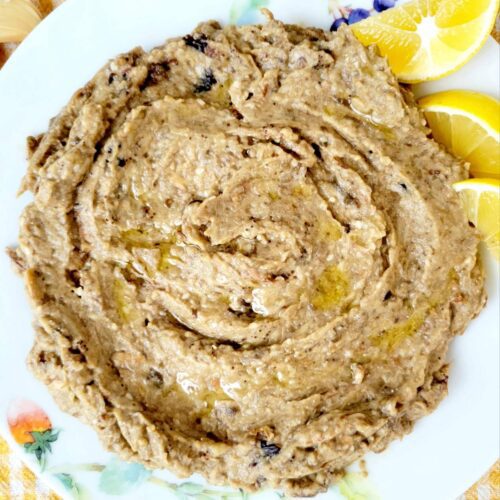
Made with tahini, olive oil, lemon, roasted garlic and salt, Moutabal is a Middle Eastern appetizer, dip, or side dish that is both healthy and delicious. The roasted garlic adds a rich but mellow, aromatic flavor.
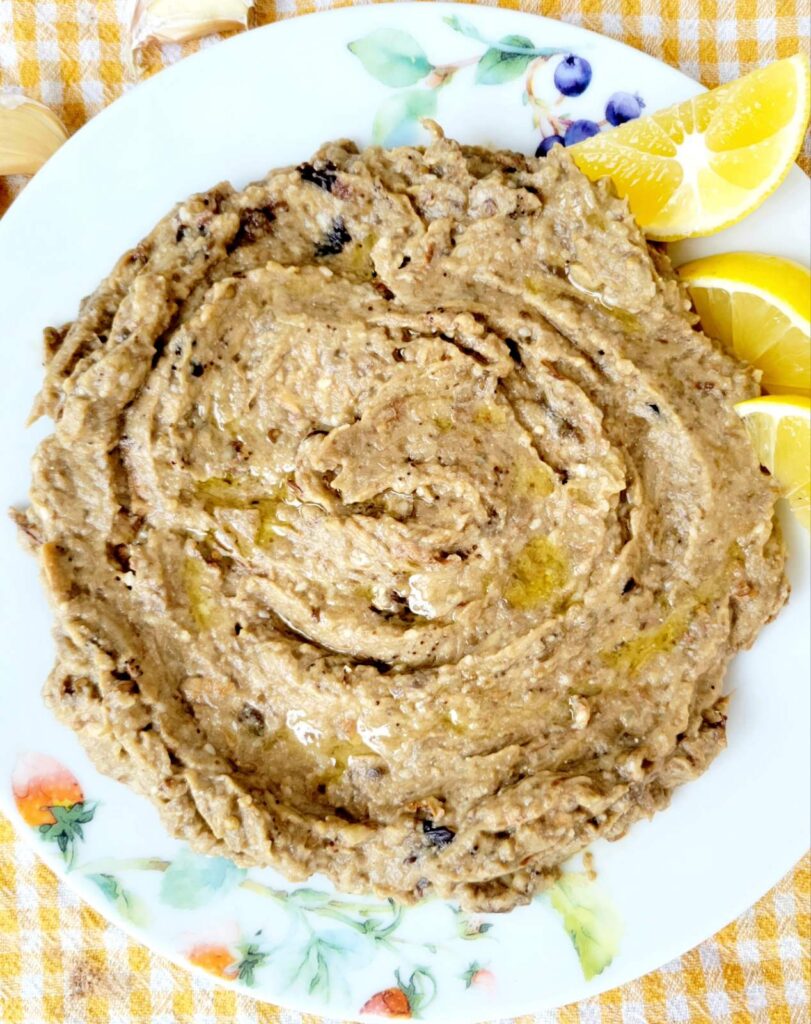
About Moutabal with Roasted Garlic
One of my favorite recipes to make at home is Roasted Garlic Moutabal. I love this Middle Eastern eggplant appetizer because it’s not just healthy, it is also low in calories and has so much flavor.
Roasting or grilling the eggplants is the secret to making this dip incredibly rich and smoky. In this post, you will learn why Moutabal is different from Baba Ghanoush, and my tips for making it perfect every time.
The Difference Between Moutabal and Baba Ghanoush
While Moutabal and Baba Ghanoush both contain eggplant, they are not the same. Traditionally, Mutabbal contains tahini and often yogurt, and it is creamy and smooth. Baba Ghanoush is a type of salad and includes chopped vegetables like tomatoes, peppers, or walnuts, and typically doesn’t use tahini.
Both recipes are absolutely delicious, but I would say that Moutabal is an elegant appetizer or side dish that you might serve at a dinner party, while Baba Ghanoush is rustic and casual. When you know the difference, you can pick the right one for your meal or occasion.
Tips for Making Moutabal
- Making Moutabal is all about layering flavors. I first roast the eggplant until its very soft and starts to develop a smoky flavor.
- When roasting your eggplant, be sure that it very soft and not firm at all, but at the same time making sure not to burn it and not to let it get completely dry.
- The roasted garlic gives a subtle sweetness that complements the tahini.
- The fresh lemon juice added to Moutabal brings out the flavors and keeps it from feeling heavy.
- It’s best to add half the lemon juice at first, then taste and add more until it suits you!
- I also love to experiment with toppings. Finishing it with olive oil drizzled over the top adds flavor and elegance to the dish.
- A sprinkle of smoked paprika, or a bit of fresh parsley takes it from simple to stunning. It makes such a difference when you’re serving guests and it tastes even better than it looks.
Why I Love Eggplants
Eggplants aren’t just tasty, they’re also extremely healthy. They contain fiber, protein, vitamins, and minerals plus antioxidants that are found mainly in the skin.
The entire eggplant is edible, including the skin and seeds, though I usually remove the seeds because they can taste bitter.
They make a great meat substitute because of its meaty texture when it’s cubed or sliced before cooking.
Eggplant also takes on a creamy consistency when well-roasted, such as in this Mutabbal recipe.
How to Choose the Best Eggplants
- Eggplants are in season in the summer months, but in many areas of the world they are available year-round.
- When puchasing eggplants, select ones that are very firm, without any bruises or soft spots. They should also be somewhat narrow, since they will often have fewer seeds.
- However, if using the narrow Chinese eggplant, you will need to use twice the number of eggplants. So I often recommend using the Globe or Italian variety.
- When the bottom end of the eggplant is not indented but rather has a slight outward bump, this also indicates that there will be fewer seeds.
- This is important to be aware of because the seeds tend to be bitter and will need to be removed after cooking.
- I always use 4 eggplants for this dish to make sure I have enough. Since the large size tends to have more seeds, 4 will still be needed whether they are medium or large.
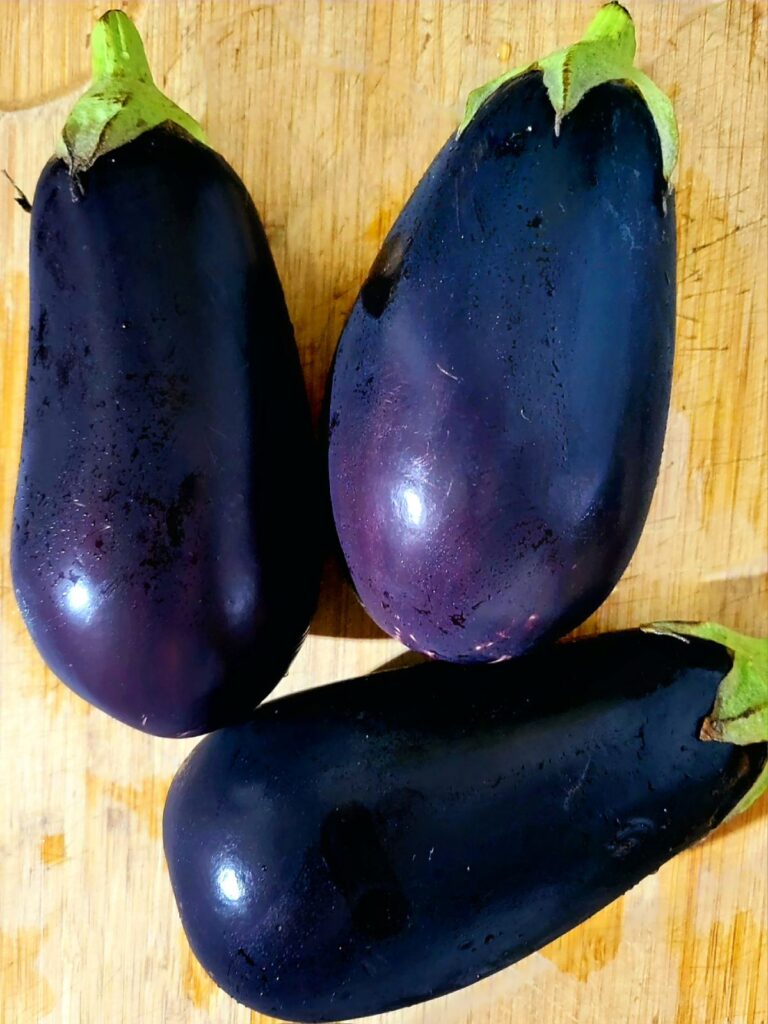
Ingredients for Mutabbal
4 medium eggplants
1/4 cup tahini
1 whole bulb of garlic
3 Tablespoons freshly squeezed lemon juice (about 1 whole lemon)
Salt to taste
How To Make Roasted Garlic Mutabbal
Rinse the eggplants under cold water .Then roast them whole or cut in half lengthwise in a preheated 400°F (200°C) oven. 1 hour for eggplants that are halved, or 1½ hours when roasting them whole.
They can also be grilled outdoors on a gas barbeque grill or indoors on a cast iron grill pan over a low flame. Keep a close eye on them and turn them every 5 to 10 minutes. This will take about 1 to 1 1/2 hours. To save time, sometimes I roast or grill them a day ahead of making the Mutabbal.
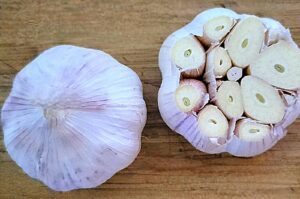
Cut the pointed top off the garlic bulb and roast it alongside the eggplants.
I usually prefer to slice the eggplants in half, drizzle them with olive oil, and place them cut-side down. This caramelizes the flesh and adds a smoky sweetness.
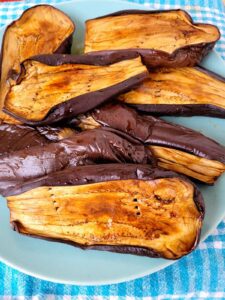
Always make sure that eggplants are very soft and the cut side is a golden brown color. Whole eggplants should be very soft and beginning to collapse. If not soft enough after 1 hour, continue to roast in 15 minute increments. Cool the eggplants to room temperature, scoop out the flesh into a bowl and remove the seeds.
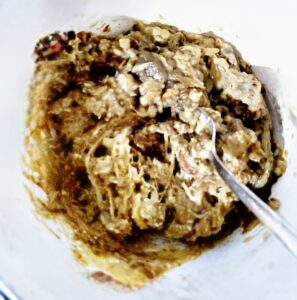
Mash with a fork and squeeze in the roasted garlic.
Stir in tahini, lemon juice, and salt. Then adjust the seasoning to taste and mix everything well.
What to eat with Mutabbal
- Mutabbal is typically served with pita bread and fresh raw vegetables like carrot, cucumber and celery sticks, jicama, or just about any vegetable you like.
- It is also delicious with lightly roasted vegetables such as carrots or mushrooms. Roasting bring out the sweetness in these vegetables and is an elegant appetizer for guests.
- I love it as a complete meal when served with these veggies and a basket of fresh, warm pita bread.
Moutabal Recipe with Roasted Garlic

Equipment
- 1 Baking Tray, Grill Pan, or Barbecue Grill
- 1 Medium Mixing Bowl
Ingredients
- 4 medium eggplants
- ¼ cup tahini
- 1 whole bulb of garlic
- 3 Tablespoons freshly squeezed lemon juice about 1 whole lemon
- 1/4 cup pomegranate seeds optional
- 1/2 tsp. Sea salt or Himalayan pink salt or to taste
Instructions
- The eggplants can be roasted in a preheated 400 degree F (200 C) oven for 1 to 1 and 1/2 hours or on an outdoor barbeque grill. You can do this step the day before if you prefer.
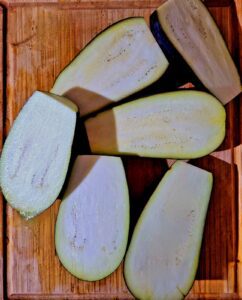
- Wash the eggplants, slice off the stem, and cut them in half lengthwise.

- Cut the top off of the pointed end of the garlic bulb.
- If grilling outdoors, line the grill with foil then preheat to high. Make a few slits in the eggplants with a small knife or with a fork. Lower the heat to medium. Leave on the grill for 1 hour, turning them every 5 -10 minutes until they become very soft and the flesh is cooked through.On a grill using charcoal briquettes, make sure that it is not too hot and keep a close watch on the eggplants to avoid burning. If roasting in the oven, preheat the oven to 400 F. (200 C). Pierce the whole or halved eggplants with the knife or fork then place them on a baking tray lined with parchment paper. Roast whole eggplants for 1 to 1.5 hours, and 1 hour for the halves.
- Remove the garlic after 45 minutes to 1 hour since it will cook more quickly than the eggplants.
- Let the eggplants and garlic cool to room temperature, then cut off the stem end of the whole eggplant and make a slit down the side. Open the eggplant, pull the seeds out and discard them. If eggplant has been cut in half before roasting, simply scoop the insides of the eggplant into the bowl and remove the seeds. Its ok if a few seeds are left behind.
- Mash the eggplant well with a fork. Squeeze the garlic from the roasted bulb into the bowl.
- Add the tahini, lemon juice, and salt. Adjust seasonings to taste and stir well.
- Place the Moutabal in a bowl or on a serving plate and drizzle with a little olive oil and pomegranate seeds if desired. Serve as an appetizer with pita bread, raw vegetables, or as a side dish.